What YC startup websites are built with in 2026
Guide · 8 min read · By Utkarsh Dhairya Panwar · Updated
Mostly Next.js. Of 231 Summer 2026 YC homepages, 112 use Next.js, 10 Framer and 3 Webflow. In Winter 2024, Framer (35) and Webflow (36) were each about half as common as Next.js (68). The new batch leans on demo requests, and just 49 of 204 readable homepages link to pricing.
The builders, counted
I design and build startup websites, mostly in Framer, and kept hearing that "every YC company is on Framer now". So I checked. On 8 October 2026 I fetched the homepage of every company listed under Summer 2026 in YC's public directory, 231 in total, and read the HTML for the fingerprints each site builder leaves behind.
For contrast I ran the same check on Winter 2024, the batch CodeAnt and xPay were in. Those companies have had two and a half years to rebuild their sites, so this compares what each batch runs today, which may differ from what it launched with.
| Builder or framework | Summer 2026 (231 sites) | Winter 2024 (197 active sites that loaded) |
|---|---|---|
| Next.js | 112 | 68 |
| Plain HTML, no framework detected | 42 | 18 |
| Vite single-page app (React or Vue) | 35 | 15 |
| Astro | 21 | 10 |
| Framer | 10 | 35 |
| Webflow | 3 | 36 |
| Lovable | 2 | 6 |
| SvelteKit | 2 | 2 |
| Nuxt | 1 | 2 |
| WordPress | 1 | 0 |
| Wix | 1 | 1 |
| Hugo or Jekyll | 1 | 0 |
| Squarespace | 0 | 2 |
| Notion-based | 0 | 1 |
| Remix or React Router | 0 | 1 |
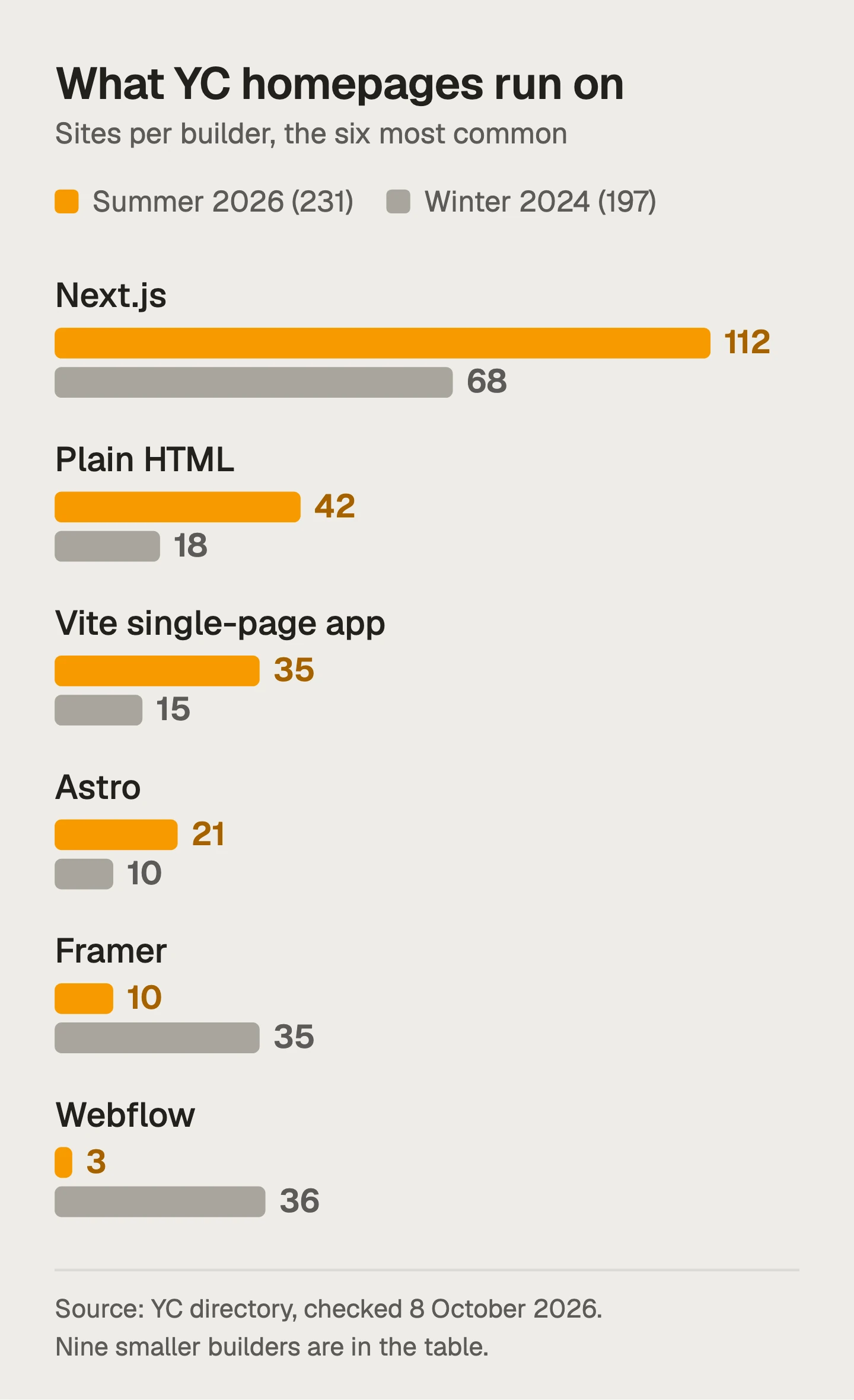
The hosting headers point the same way. 113 of the 231 Summer 2026 sites answered with Vercel headers, 63 came through Cloudflare and 9 from Framer's own hosting.
Why the newest batch writes code instead of using a builder
The counts can't say why. My guess, from building sites for YC companies: a founder with an AI coding tool can get a decent Next.js landing page running in an afternoon, deploy it to Vercel for free, and never open a visual builder. The 42 plain-HTML sites fit the same pattern. Many load a single hand-named script like main.js or hero.js and nothing else, which is what generated or hand-written pages tend to look like.
That works at launch. The cost shows up when marketing wants a new landing page and every change goes through an engineer. Winter 2024 hints at what comes next: 71 of its 197 live sites run on Framer or Webflow, against 13 of 231 in the new batch. Teams seem to move to a visual builder once someone other than a founder owns the site.
Calls to action: demo requests beat free trials
27 of the 231 Summer 2026 homepages return an empty shell until JavaScript runs, so I read buttons and links on the other 204 and sorted every label into four groups.
| Call to action on the homepage | Summer 2026 (of 204 readable) | Winter 2024 (of 173 readable) |
|---|---|---|
| Demo or sales call (Book a demo, Talk to us, Book a call) | 98 | 107 |
| Self-serve (Get started, Sign up, Start free, Download) | 61 | 75 |
| Plain contact link (Contact, Get in touch) | 99 | 79 |
| Waitlist or early access | 20 | 4 |
| None of these found | 34 | 15 |
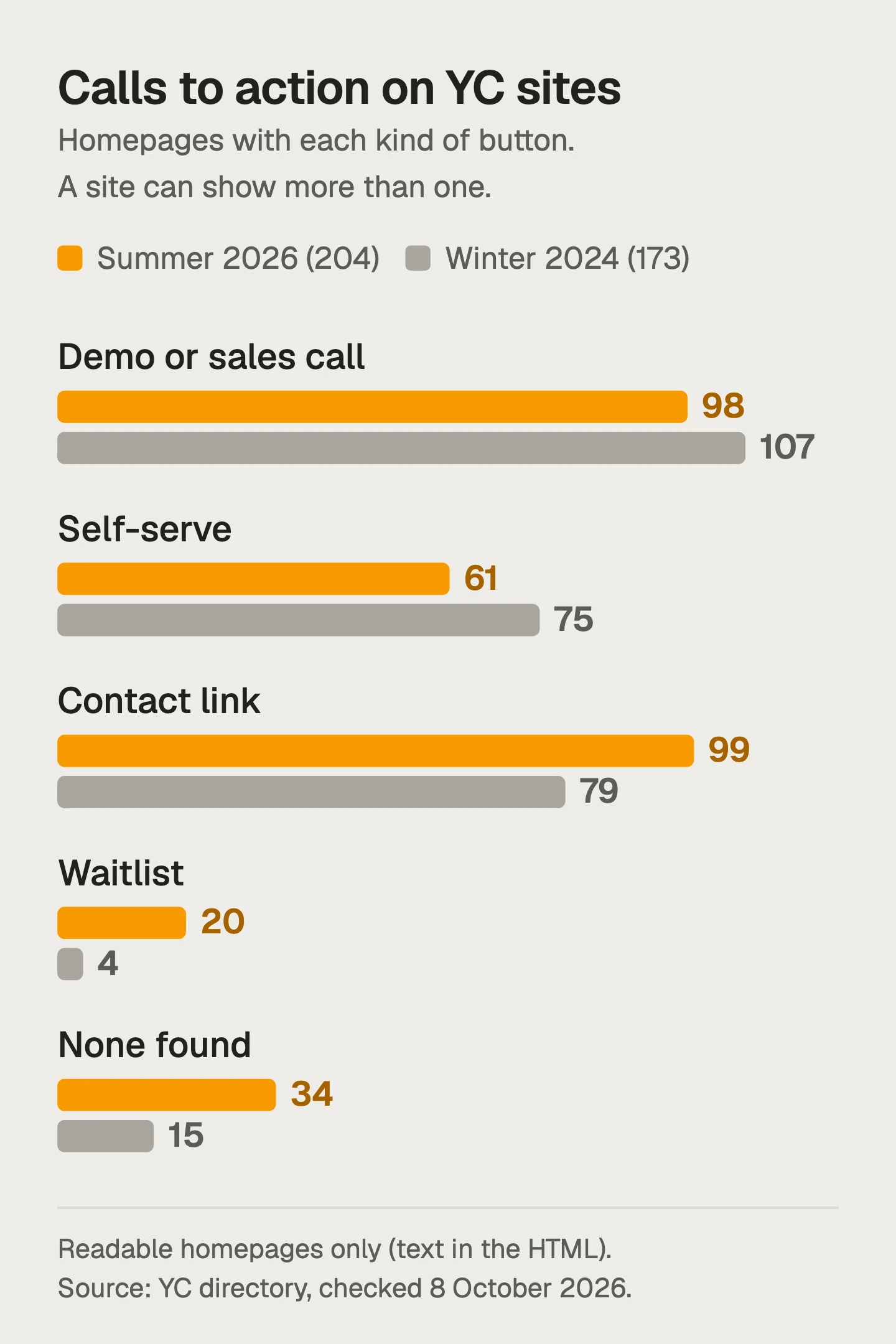
The first call to action in the HTML, usually the header button, was a demo or sales call on 67 Summer 2026 sites and a self-serve action on 35. "Book a demo" alone was the first button on 30 sites. "Get started" led on 12. Twenty companies still run a waitlist, five times the Winter 2024 count, which fits a batch that has only just launched.
Industry matters more than batch here. Of the 123 readable B2B and fintech homepages, 71 offer a demo. Of the 48 industrials (robotics, hardware, energy, space), 12 do, 19 have only a contact link and 15 have no call to action I could find.
Pricing links are rare, and SEO basics are mostly there
- Pricing in the HTML: 49 of 204 readable Summer 2026 homepages link to a pricing page. For B2B and fintech it's 41 of 123. For industrials it's 1 of 48. Winter 2024 shows 67 of 173.
- Meta description: 224 of 231 Summer 2026 homepages have one.
- Social preview image (og:image): 182 of 231. Share one of the other 49 in Slack or on LinkedIn and it shows a bare title.
- Text in the HTML: 27 of 231 homepages send no readable text until JavaScript runs. 15 of those are Vite single-page apps.
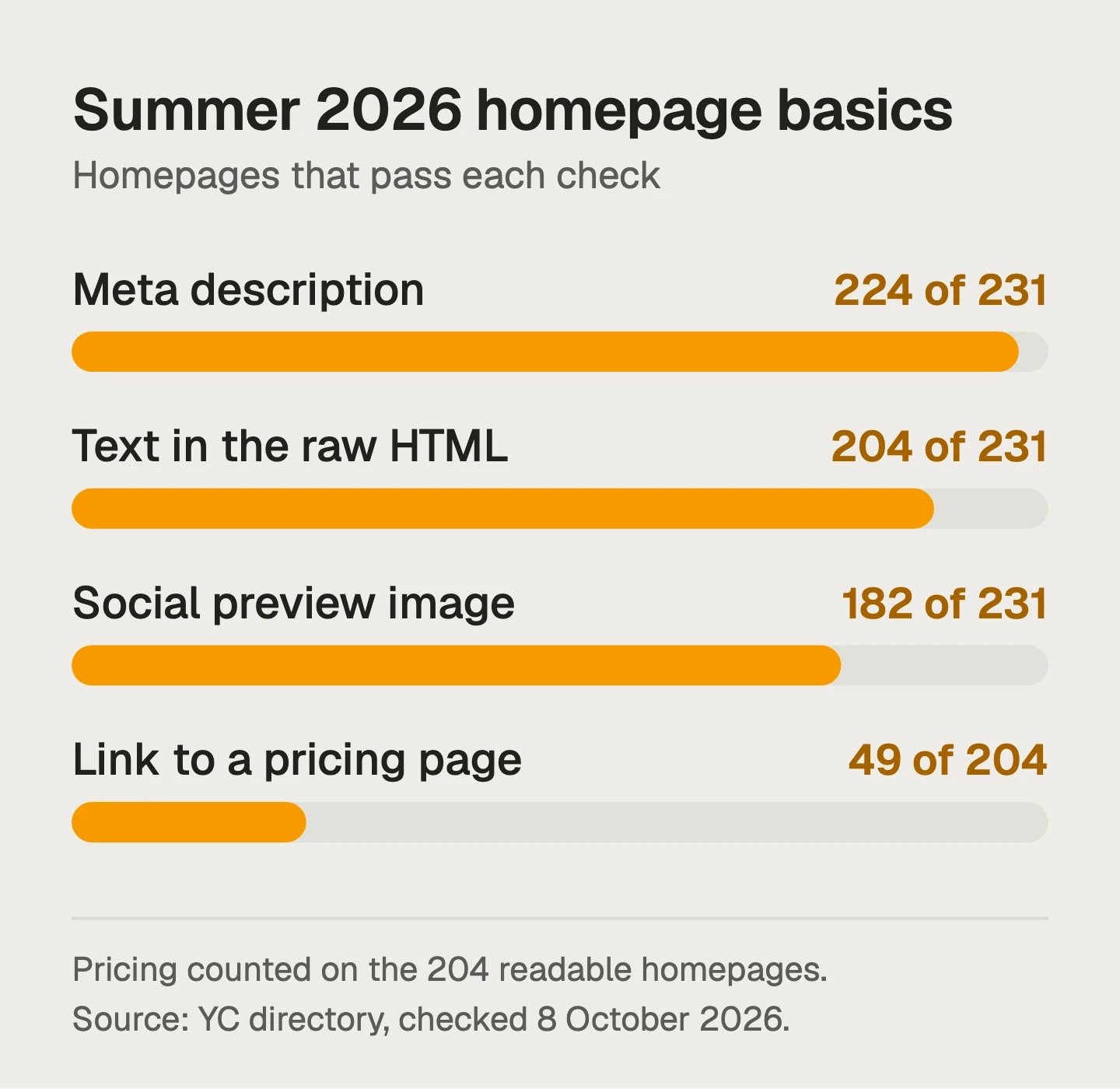
I'd fix that last group first. Google renders JavaScript, slowly. Many other crawlers, including the ones that feed AI assistants, read the raw HTML and see an empty page. All 13 Framer and Webflow sites in Summer 2026 sent their text in the HTML, and 69 of 71 in Winter 2024, because both builders publish pre-rendered pages by default.
The Summer 2026 sites built on visual builders
The full list runs to 231 rows. These are the 17 built on a no-code or low-code builder, with the first call to action each shows.
| Company | Builder | YC industry | First call to action |
|---|---|---|---|
| Allia Health | Framer | Healthcare | Book a demo |
| Bernard | Framer | B2B | Contact |
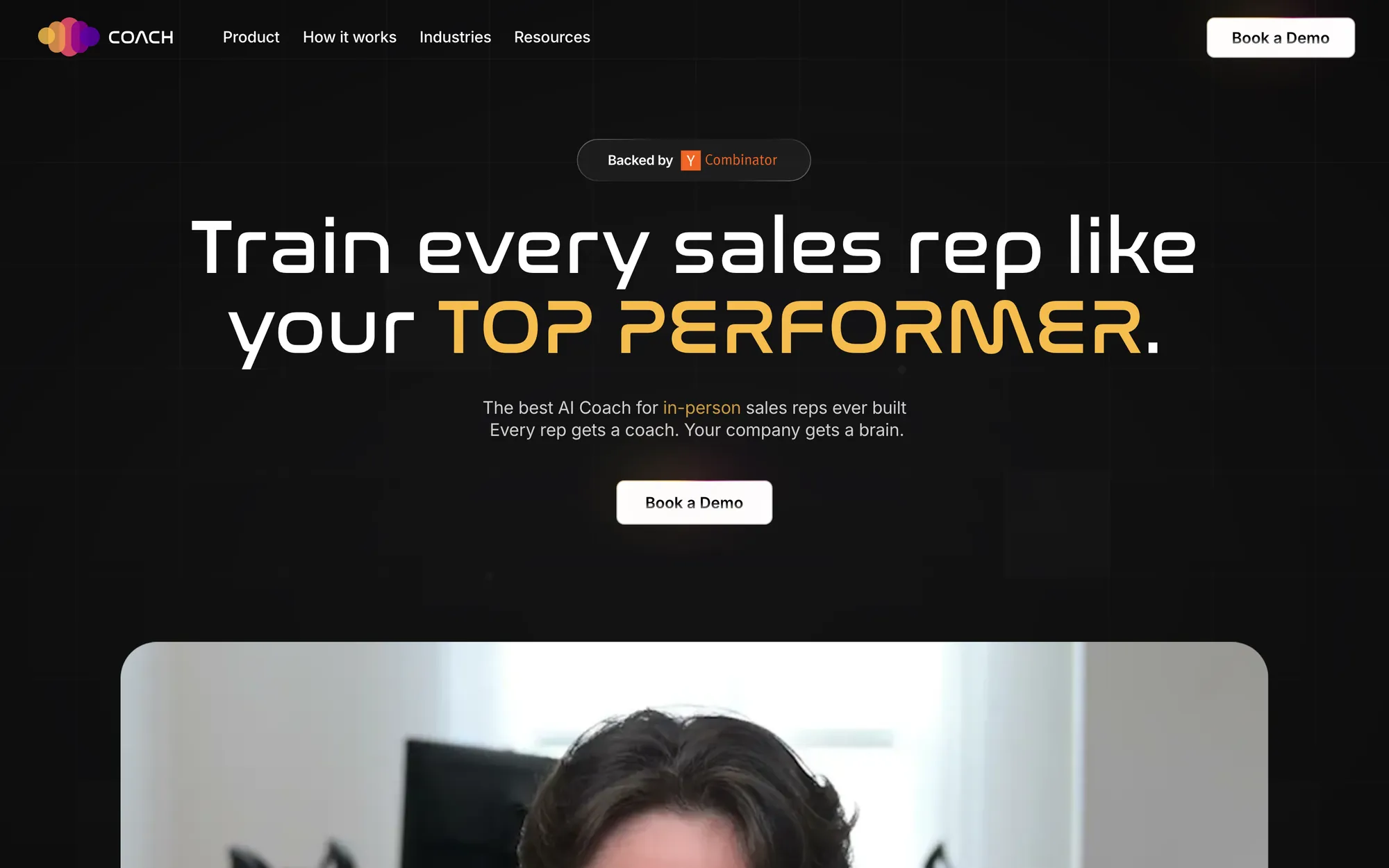
| COACH | Framer | B2B | Book a Demo |
| Derya | Framer | B2B | Get Started |
| Gutgutgoose | Framer | Healthcare | Get started |
| Nex | Framer | B2B | Install CLI |
| Pluto | Framer | B2B | Sign Up |
| tash | Framer | Consumer | Join waitlist |
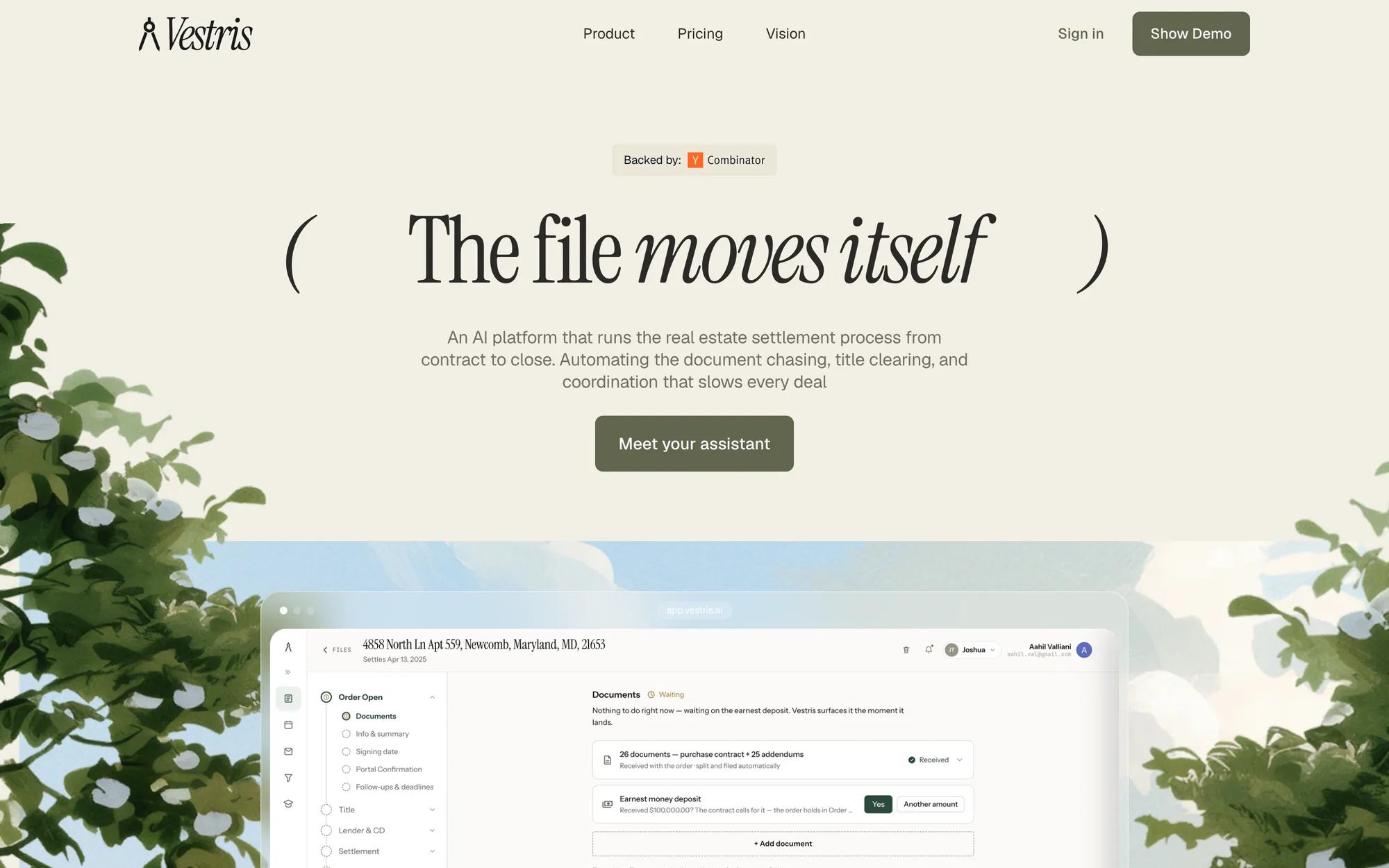
| Vestris | Framer | Real Estate and Construction | Show Demo |
| Zaplar | Framer | B2B | Contact |
| Atomarine | Webflow | Industrials | Contact |
| Exosat | Webflow | Industrials | None found |
| Traceforce | Webflow | B2B | Get started |
| Dipole Labs | Lovable | Industrials | Contact |
| Touchmark | Lovable | B2B | None found |
| Ethos Space Resources | WordPress | Industrials | Contact |
| Rise Reforming | Wix | Industrials | None found |
What I'd take from this for your own site
- Pick the tool for who edits the site next year: A coded site is fine while a founder owns it. Once a marketer needs a page live this week, Framer or Webflow saves an engineering ticket per change, and the Winter 2024 numbers suggest many teams get there.
- Make sure the HTML has your words in it: Open view-source on your homepage. If your headline isn't there, pre-render it. This matters more now that people ask AI tools which product to buy.
- Decide demo or trial on purpose: Most B2B pages in this batch lead with a demo. That's right when setup needs an admin or a contract. If your product works the day someone signs up, lead with the trial, as CodeAnt does with its free pentest, and keep the demo as the second button.
- Say something about price: Two in three B2B homepages here give no route to pricing. Even "From $X" or "Talk to us for volume pricing" answers the question a buyer has before booking a call.
If you've settled on Framer and want these choices made early in the design and build, that's my Framer website work.
How I checked
- Date: 8 October 2026. One snapshot, taken the same day for both batches.
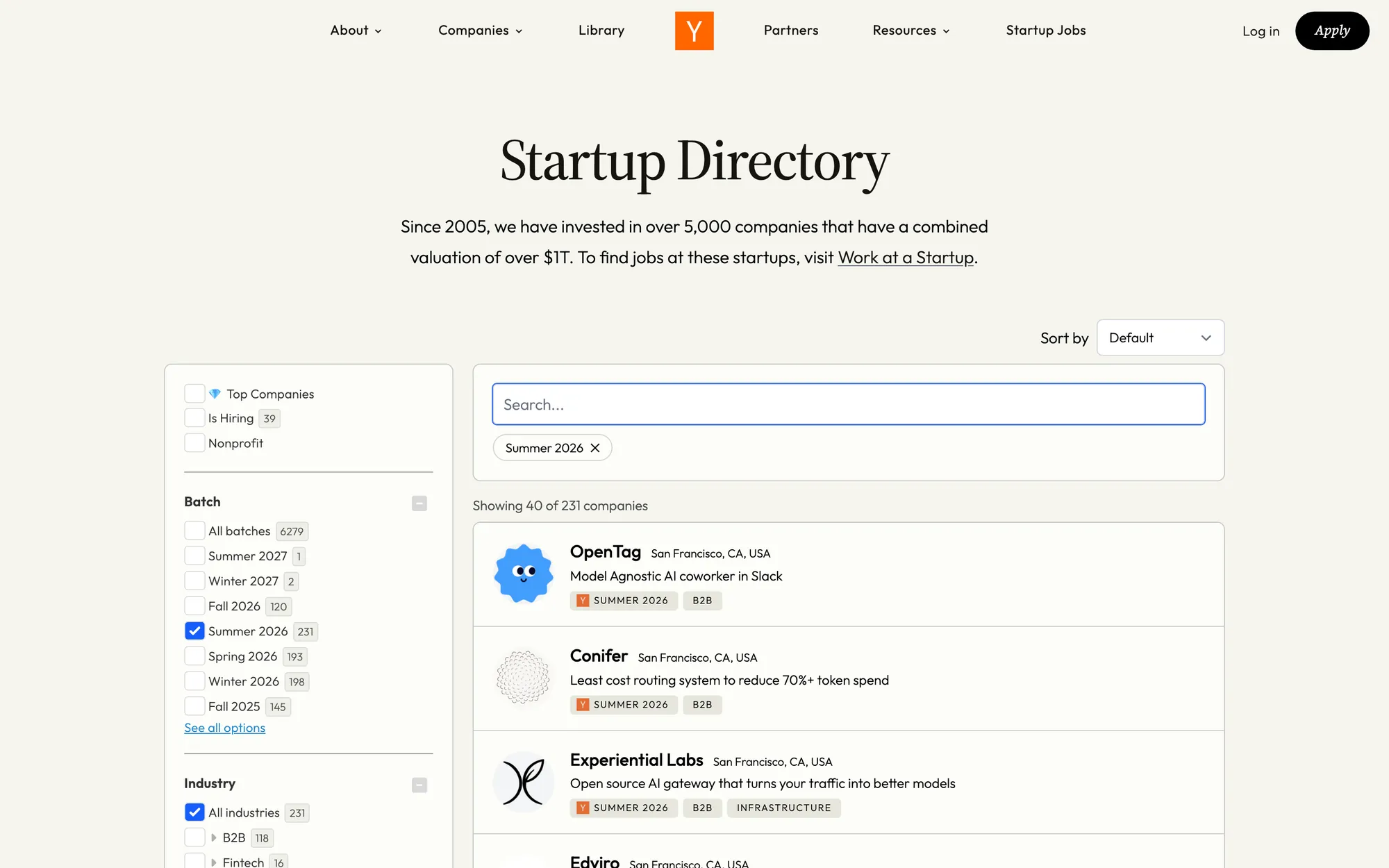
- Sample: every company YC's public directory (ycombinator.com/companies) lists under Summer 2026, 231 companies, all with a website, all of which loaded. For Winter 2024 I took the 210 companies marked Active; 197 loaded and the 13 that errored, timed out or blocked the request are left out.
- Fetch: one request per homepage with curl, following redirects, using a desktop Chrome user agent. No JavaScript was run, so these are the pages a simple crawler sees.
- Builder detection, in this order: Framer (framerusercontent.com assets or a Framer generator tag), Webflow (data-wf-site or Webflow asset hosts), WordPress (wp-content), Wix, Squarespace, Lovable, then frameworks: Next.js (/_next/ or __NEXT_DATA__), Nuxt, Astro, SvelteKit, Remix, Hugo or Jekyll generator tags, and Vite builds. Anything else counts as plain HTML.
- Calls to action: every link and button label under 40 characters, matched against phrase lists (demo, sales and call phrases; get started, sign up, start free, download; waitlist and early access; contact). "First" means first in the HTML, usually the header.
- Pricing link: any link whose address contains "pricing" or whose label is "Pricing".
Limits: a site served through a proxy can hide its builder, so Framer and Webflow counts are a floor. Plain HTML may include sites made with tools that leave no trace. The 27 empty-shell pages are excluded from the CTA and pricing counts rather than guessed. I have the full spreadsheet with every company, URL and result; email me at work@utkarshdesign.com if you want it.
Questions people ask
What do most YC startups build their website with?
In the Summer 2026 batch, Next.js: 112 of 231 homepages. Plain HTML (42) and Vite single-page apps (35) come next. Framer had 10 and Webflow 3.
Do YC startups still use Framer?
Older batches do. In Winter 2024, 35 of the 197 live sites run on Framer and 36 on Webflow. The newest batch mostly ships coded sites, often deployed on Vercel.
Is Next.js better than Framer for a startup website?
Neither is better in general. Next.js suits a site engineers own; Framer suits a site designers and marketers change every week. The deciding question is who edits it after launch.
Do YC startups put pricing on their website?
Mostly not. 49 of 204 readable Summer 2026 homepages link to pricing, and 41 of those 49 are B2B or fintech companies.
Sources
- The YC Startup Directory, Y Combinator
- Understand JavaScript SEO Basics, Google Search Central
- The rise of the AI crawler, Vercel
Working on this?
Tell me what you're building and where it's stuck: book a 30-minute call, email work@utkarshdesign.com or send a brief.