How to define an activation metric
Guide · 7 min read · By Utkarsh Dhairya Panwar · Updated
An activation metric is the first logged action that shows a new account got real value and predicts it will pay. Activation rate is the share of signups who reach it within a set window. Pick the candidate event that best separates payers from non-payers, and never count setup.
Aha moment, activation event, activation rate
- The aha moment is a feeling: the point where a user thinks "oh, this is useful". You can't log a feeling.
- The activation event is the action you can log that tells you the aha moment probably happened. It's your proxy.
- Activation rate is the share of new accounts that reach that event within a set window, such as the first seven days or the trial.
I only count a moment as an aha if the user sees real output from their own work, before they've decided to leave. A dashboard full of dummy data fails that every time, and so does a finished checklist with nothing produced.
Teams usually skip the middle term. They name the aha moment in a workshop, pick whatever event is easiest to track and call it activation. That's how you end up celebrating a number that doesn't move revenue.
| Term | What it measures | CodeAnt example |
|---|---|---|
| Aha moment | The felt realisation that the product works for me | Reading a useful review on my own pull request |
| Activation event | The tracked action that stands in for the aha | First pull request reviewed |
| Activation rate | Share of signups who reach that event in a fixed window | Measured per account over the trial |
| Time to value | How long it takes to get there | Shortened by removing waits, see the time-to-value guide |
| Trial-to-paid | Share of trials that convert to paying | Usually moves after activation does |
The activation rate formula, and the two choices inside it
Activation rate = (accounts that reached the activation event within N days ÷ accounts that signed up in the same period) × 100.
The number is only as good as two decisions behind it: which event counts, and how long you give people to reach it. A seven-day window suits a tool people try during a working week; a product used monthly needs longer. Keep the window fixed, or this month's rate can't be compared with last month's. And count by the unit that pays, which for most B2B tools is the workspace or org (more on that below).
Why "repo connected" was the wrong event at CodeAnt
CodeAnt AI is a code health platform: AI code review, security scanning, code quality and developer metrics. Nothing works until a repository is connected, so connecting one looked like the obvious activation event. It sat at the end of onboarding and was easy to count.
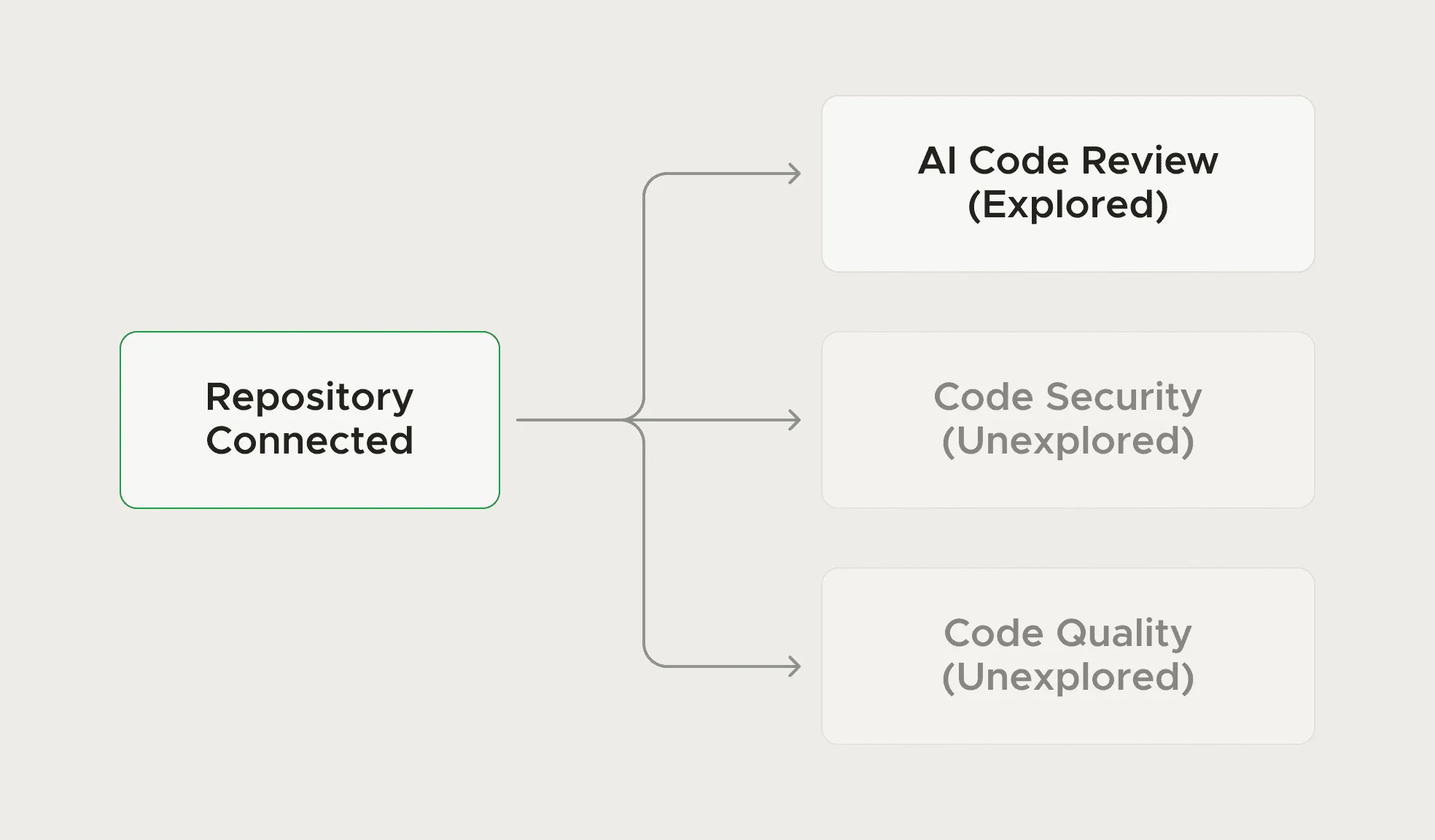
Connecting a repo only grants access. Nothing has been reviewed yet. Plenty of accounts connected and never found the reviews or checks they came for, and counting them as activated made onboarding look healthier than it was.
What a developer wants from a code review tool is a useful review on their own pull request. So the event that mattered was the first pull request reviewed, with the user knowing the review had worked.
Five steps to define your activation metric
- Write the promise in one sentence: What did the user sign up to get? "Reviews on my pull requests", "a dashboard my manager reads", "invoices that go out on time". The event has to show that sentence came true, so steps on the way there don't qualify.
- List every candidate event: Usually five to ten: account created, integration connected, first object created, first output received, first output shared, teammate invited, second session. Write them in order.
- Strike out anything that is only setup: Connecting, configuring and importing are prerequisites. Keep them as funnel steps, but they can't be activation on their own.
- Check which event separates payers from non-payers: Take recent trial accounts. For each candidate, split them into reached it or didn't, then compare how many in each group paid. The best event shows the widest gap, and enough accounts reach it to be worth chasing.
- Add a window and a threshold: "Reached it within the trial" or "did it twice in the first week". A window keeps the metric honest about speed, and a threshold filters out accidental one-offs.
Step four doesn't need a data team. A spreadsheet of a few hundred trials with yes or no columns is enough to see which event matters. It only shows correlation, so I treat it as a strong hint, then test it by pushing more people toward the event and watching whether conversion follows.
In B2B, activation belongs to the account
Most activation advice assumes one person signs up and gets value. At CodeAnt the developer who found the tool often couldn't connect the company repo, because that needed an org admin, so activation took two people.
Measure activation per account: an account is activated when the value event happens anywhere inside it. Then track the hand-offs that lead there as their own funnel steps: request sent to an admin, admin approved, teammate invited. Those steps are where B2B activation usually breaks, and a per-user metric hides them.
Tell users when they've arrived
When users can't tell they've succeeded, many stop just short or leave unsure whether setup worked. At CodeAnt, making the first-PR success criteria plain in the product was one of the two changes in the onboarding tests that doubled activation.
How CodeAnt doubled trial-to-paid: The full story: the admin wall, the hand-off, the shorter setup and the trial emails.
Mistakes that make the number lie
- Picking the event that's easiest to track instead of the one that means value.
- Calling login count or time in app activation. A busy user may still be stuck.
- Faking the aha with sample data, which shows off the interface and proves nothing about value.
- Changing the definition mid-quarter and comparing the new rate with the old one.
- Blending very different signups into one rate. CodeAnt's self-hosted and cloud users had different setup paths, and a single rate couldn't show where each group stalled.
- Never revisiting it. Re-run the payer check after big product changes, because last year's predictor may not hold now.
To see what a change in activation would do to revenue, the activation calculator splits trial-to-paid into activation and the paid share of activated accounts. If you're unsure your current event is the right one, the onboarding audit starts by checking exactly that.
Questions people ask
What is a good activation rate?
Published benchmarks exist, but every company defines the event and window differently, so cross-company numbers mislead more than they help. Compare against your own past cohorts with a fixed definition and watch the trend after each onboarding change.
How do you find your product's aha moment?
Ask retained users what made them stay, then compare the early actions of accounts that stayed with those that left. The action that separates them is your best candidate for the activation event.
Is activation the same as onboarding completion?
No. Completion measures whether people finished your steps. Activation measures whether they got value, which can happen before, after or entirely outside the checklist.
Can a B2B product have more than one activation event?
Yes, if different roles or product lines sign up for different things. Keep one per main use case and report them separately rather than blending them.
Sources
- What is Activation Rate for SaaS Companies?, Amplitude
Working on this?
Tell me what you're building and where it's stuck: book a 30-minute call, email work@utkarshdesign.com or send a brief.