User interview questions template
Template · 7 min read · By Utkarsh Dhairya Panwar · Updated
Good user interview questions ask about specific things people have already done, not what they would do or want. Start with "Tell me about the last time you…" and follow the story with probes like "What did you do next?" and "What made that hard?"
The session guide (45 minutes)
- Set-up (3 minutes): "Thanks for making time. I'm trying to understand how you [do the activity], not to sell you anything or test you. There are no right answers. Is it okay if I record so I can listen properly instead of typing?"
- Their context (5 minutes): Role, team, typical week, the tools on their screen. For consumers: routine, devices, when and where the activity happens.
- The last time (15 minutes): One specific, recent instance of the problem, told as a story from start to finish. This is most of the interview. Stay with it while there's still detail to get.
- Workarounds and spend (10 minutes): What they use now, what they tried and dropped, what it costs them in money or time. A workaround is the strongest evidence a problem is real.
- Priorities (7 minutes): Where this sits against the other problems in their week. A real problem that ranks seventh won't get bought.
- Wrap-up (5 minutes): "What should I have asked that I didn't? Who else should I talk to?" Thank them; confirm any incentive.
Question bank: B2B products
- Walk me through the last time you [did the task], from what triggered it to when it was done.
- Who else was involved? Who had to approve anything?
- Where did it slow down or stall? What did you do while waiting?
- What tools were open while you did it? Which one would you miss most?
- Have you tried to fix this before? What happened to that attempt?
- How do you know when it's gone well? Who would notice if it went badly?
- If this problem disappeared tomorrow, what would you do with the time?
- How did you end up using your current tool? Who chose it, and who pays for it?
- What would make you stop using it?
In B2B, always ask who else is involved. The person feeling the pain often isn't the one with access or budget. At CodeAnt AI (YC W24) that gap was the activation problem: developers wanted the product, but connecting a repository needed an org admin who had never heard of it.
Question bank: consumer products
- Tell me about the last time you [did the activity]. Where were you? What time of day?
- How did you decide what to [watch, buy, eat, listen to]? What did you look at first?
- What did you almost choose instead?
- When did you last give up halfway through? What made you stop?
- Can you show me on your phone how you usually do this? (Then watch, don't narrate.)
- Who do you do this with? How do you decide together?
- What do you spend on this in a normal month, in money or time?
- What's the most annoying part, and what do you do about it?
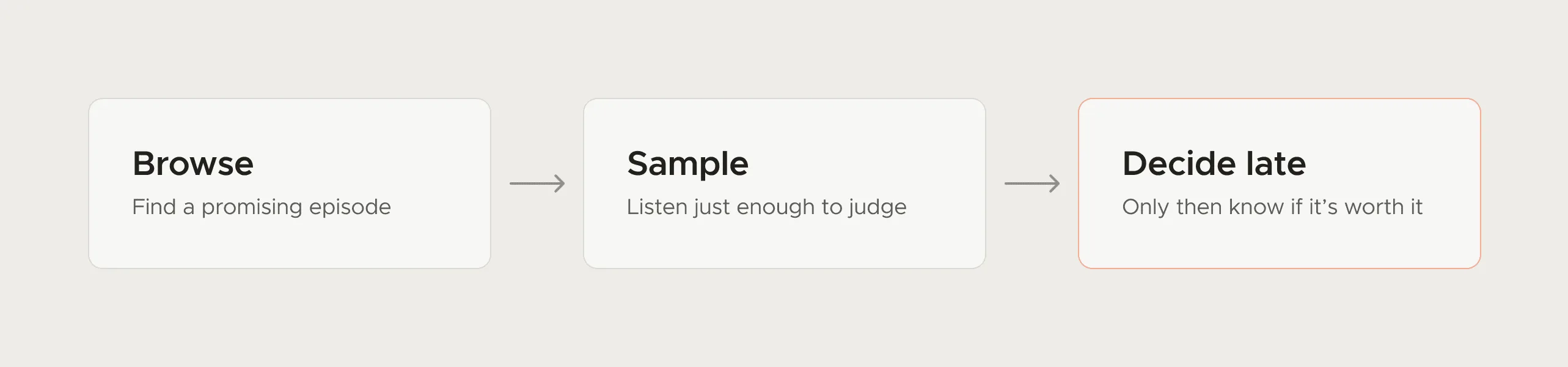
SoundSphere was a 4-week concept for a podcast app, and its research kept coming back to one line: "I don't know if it's worth starting." That line came from asking how people choose an episode. Ask whether they'd like AI summaries and almost everyone says yes, which tells you nothing.
Follow-up probes
Prepared questions open a topic; the useful detail comes from probes. I keep these on a card in front of me.
- "What happened next?"
- "Why was that?" (once, gently; asked five times it becomes an interrogation)
- "Can you give me an example?"
- "How did you feel at that point?"
- "You said it was annoying. What exactly was annoying?"
- "How often does that happen?"
- Silence. Wait three seconds after they stop. People often add the important part then.
What not to ask, and what to ask instead
| Don't ask | Why it fails | Ask instead |
|---|---|---|
| "Would you use a product that…?" | Hypothetical. People are generous about the future and wrong about it. | "When did you last try to solve this? What did you use?" |
| "How much would you pay for this?" | Nobody knows, and they'll guess low or high to be polite. | "What do you pay for your current way of doing it?" |
| "Do you like this design?" | Invites politeness, and reactions to a design belong in a test. | Save designs for usability testing. |
| "Isn't it frustrating when…?" | Leading. You've told them the answer. | "What's that part like for you?" |
| "What features do you want?" | Users describe solutions they've seen elsewhere. | "What were you trying to get done when you got stuck?" |
| "Do you usually…?" | Invites an idealised average. | "Tell me about the last time." |
| Two questions in one breath | They answer the easier one. | One question, then wait. |
Interview both sides, then write it up the same day
When a product sits between two groups, interview both. For Campus Food Systems, a McDonald's x IIT Roorkee project, the five-designer team I was on did field research with 40+ students and 5+ canteen owners. Students cared about speed and clarity when ordering group meals; owners cared about throughput. The kiosk and group-ordering system had to work for both. Interviewing one side would have missed half the constraints.
| Note field | What to write within an hour of the call |
|---|---|
| Who | Role, context, how they were recruited |
| The story | The last-time story in five to eight bullet points, in order |
| Workarounds | Tools, hacks, spreadsheets, people they ask |
| Quotes | Two or three, exact words |
| Surprises | Anything that contradicts what the team assumed |
| Strength of the problem | High, medium or low, with the evidence: time, money, workarounds |
After five or six interviews the patterns are usually clear enough to act on. If they aren't, your questions are probably too broad. Once you're testing designs rather than learning about the problem, switch to my usability test script.
Questions people ask
How many user interviews do you need?
Five to eight per user type usually shows the main patterns. Interview each distinct group separately, such as users and buyers, or customers and operators.
How long should a user interview be?
Around 30 to 45 minutes. Shorter rarely reaches a full story; longer tires people and the last part adds little.
What is the difference between a user interview and a usability test?
An interview explores people's behaviour and problems, usually without showing a design. A usability test watches people try to complete tasks in a design.
Sources
- User Interviews 101, Nielsen Norman Group
- Avoid Leading Questions to Get Better Insights from Participants, Nielsen Norman Group
- How Many Participants for a UX Interview?, Nielsen Norman Group
Working on this?
Tell me what you're building and where it's stuck: book a 30-minute call, email work@utkarshdesign.com or send a brief.